Technical data & installation
Material properties, technical values and installation guidance for Slate-Lite.
Technical values apply to the tested material version and the build-up described. Agree suitability, available sizes and relevant test documentation for the specific product and project with Syma Stones.
Material & dimensions
- System build-up
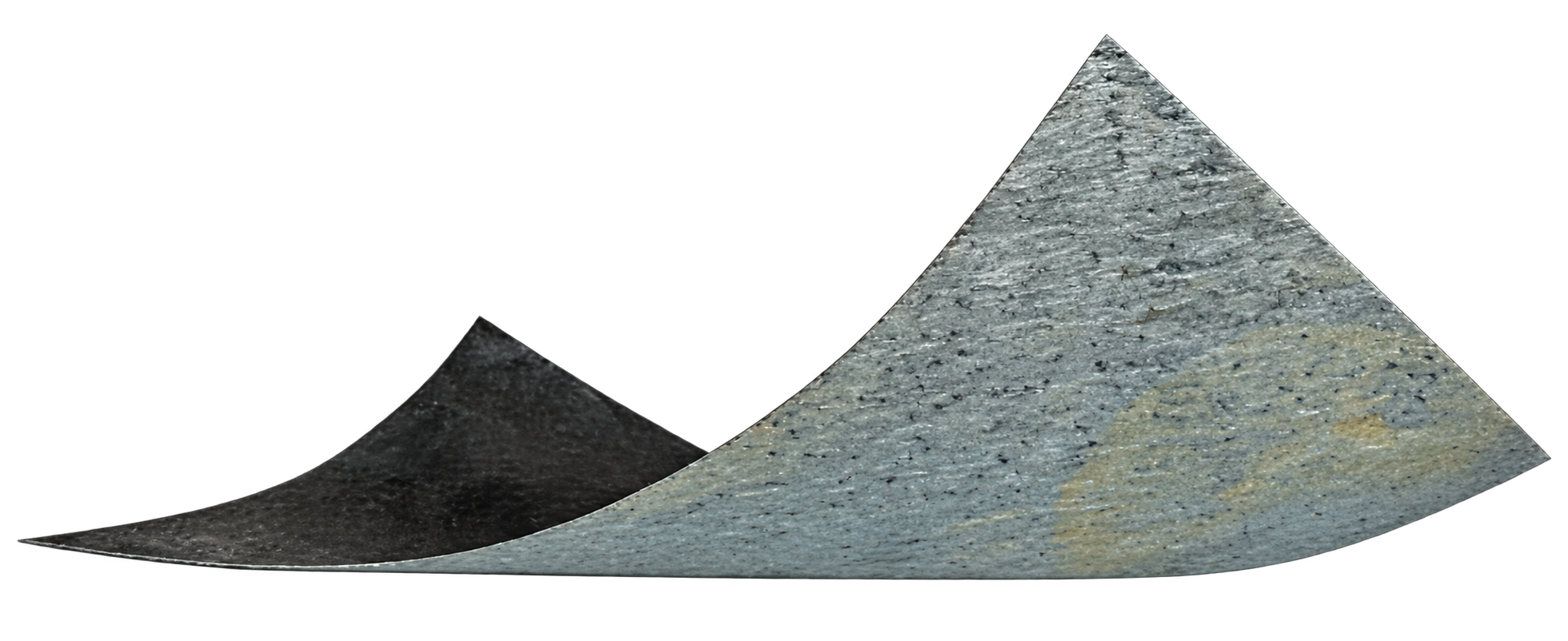
- Natural stone layer approximately 0.1–1.4 mm thick on a fibreglass-reinforced polyester backing.
- Overall thickness
- 1,5–2,0 mm
- Weight per unit area
- approx. 1.5–2.8 kg/m²
- Sizes
- 1,220 × 610 mm; 2,400 × 1,200 mm; 2,600 × 1,200 mm on request. Confirm availability for each finish.
- Dimensional tolerance
- ± 1.5 mm in length, width or diagonal, depending on the material version.
- Bending radius
- approx. 5 cm for the material version described.
- Temperature resistance
- Up to 120 °C for the tested material version; not approved for direct flame contact or a complete fireplace build-up.
- Thermal expansion
- 0.5–0.8 mm per linear metre for a temperature change of 90 °C.
- Stone layer: main components
- Approximate values: oxygen (O) 44.6%, carbon (C) 31.0%, silicon (Si) 13.0%, aluminium (Al) 5.6%, iron (Fe) 3.4%, potassium (K) 2.4%.
- Backing: components
- Oxygen (O) approx. 73.0%, carbon (C) approx. 26.0%. Confirm composition and absence of formaldehyde for the selected material version.
Natural stone varies in colour, veining and texture. Samples do not show every possible difference. For larger surfaces, agree sheet selection and layout with our team.
Test values
- Water absorption
- +2.5% on unsealed material according to ASTM C-121.
- UV testing
- UV-B according to DIN EN ISO 11507: 4 h irradiation at 50 °C / 4 h condensation at 40 °C; 1,000 h total, assessed after 250, 500 and 750 h. Colour change according to DIN EN ISO 11664-4; X-Rite Sp62, d/8°, D65. Result for the tested material: slight, uniform colour changes.
- Reaction to fire
- Test classifications: Cfl-s1 for flooring and B1 according to DIN 4102; C-s3,d0 for a specific composition. These values do not apply universally to all finishes, backings, adhesives and installation conditions. Request the appropriate current test report.
- Abrasion
- Class 2 according to DIN EN ISO 10545-7; Falling Leaves and Argento were tested. Classification scope: low abrasive soiling, private residential areas excluding kitchens, stairs, terraces and loggias.
- Slip resistance
- R9 for tested multicoloured slate, R10 for tested mica schist. Confirm the classification of the chosen surface before use.
- CE standard reference
- DIN EN 15102:2011-12 and DIN EN 15102:2008+A1:2011. The valid declaration of performance for the chosen product is the determining document.
Floor installations are the installer’s responsibility, without a manufacturer’s warranty for this use. The stated abrasion values are not general approval for flooring. Request advice on your specific build-up.
Installation
- Application temperature
- 10–35 °C; follow the requirements for the selected material and adhesive.
- Substrates
- Including wood, metal, glass, plasterboard, concrete, PVC, insulation, render and aerated concrete. Preparation and adhesive must suit the specific substrate.
- Tools
- Wood saw blade and wood or metal drill bits; for industrial processing, diamond-tipped cutting tools reduce wear.
- Adhesive tape
- Do not use strongly adhesive tape or leave tape on the surface for long periods. Test tools and processing methods on an offcut or an inconspicuous area first.
- Pressing onto boards
- Assembly with 1K PU adhesive, 120 g/m² balancing paper or 0.8 mm HPL, and 7 mm rubber pads of 50 Shore hardness. Match the adhesive, pressing pressure and build-up before use.
- Pressing with D4 PVA wood glue
- For suitable assemblies in a woodworking press: D4 PVA wood glue and 30–80 N/cm². This is not a universal pressing instruction; have the adhesive, pressure and build-up professionally confirmed beforehand.
Possible uses include doors, gates, stove surrounds, ceilings, walls, furniture, façades, roofs, floors and wet areas. Each build-up requires an application-specific assessment. Limestone variants are not suitable for wet or outdoor areas.
In showers and bathrooms, the stone sheet does not replace waterproofing. For heat-exposed and outdoor applications, the entire build-up, including substrate, adhesive, joints and protection, must be suitable.
Adhesives & joints
- SytoFix – description
- Ready-to-use elastic construction adhesive for full-surface bonding. Check the polymer base and formulation in the data sheet for the chosen version.
- Properties
- Anthracite; high initial tack; permanently elastic; repositionable and paintable; for indoor and outdoor use. Test compatibility and resistance to staining on the chosen natural stone first.
- Substrates and limitations
- Absorbent and non-absorbent substrates, e.g. concrete, wood, metal, tiles or natural stone. Not for PE, PP or PTFE.
- Installation
- The substrate must be clean, dry and free of dust and grease. Use a B3 notched trowel at a 60° angle. Only spread adhesive over an area that can be covered within 10 minutes and provide adequate support. Follow the selected adhesive’s instructions.
- Load capacity
- After 24–48 h, depending on temperature and substrate. Check the curing time for the specific product.
- Tool cleaning
- Only use Fix All Cleaner, Swipex or white spirit if compatible with the selected adhesive and tools.
- Natural stone silicone
- Neutral-curing joint sealant for porous natural stone and sanitary joints. Look for permanent elasticity, UV and colour resistance, fungicidal properties and prevention of edge staining when choosing a product. Ask about available colours.
- Joint installation
- Manual or pneumatic gun; +5 to +35 °C. Clean tools immediately with a compatible cleaner, smooth before a skin forms and repair with the same product. Use soap solution or Soudal smoothing agent only after confirming compatibility.
Before ordering and installation, agree the appropriate, available adhesive and sealant with Syma Stones.
Profiles
- Edge and divider profiles
- 299: 2,50 m; 355: 1,00 / 2,50 / 5,00 m; 365: 1,00 / 3,00 m.
- Angle profiles
- 277 and 278: 2.50 / 5.00 m each.
- External corners
- 150 U / 150 G and 155 U / 155 G: 2.70 m.
- Internal corners
- 160 U / 160 G: 2,70 m.
- Divider profiles
- 170 U / 170 G: 2,70 m.
- Markings
- U = undrilled; V = countersunk holes; G = double-K punched.
- Surfaces
- Depending on the profile: natural or polished aluminium; anodised in stainless steel effect, silver, gold, bronze or sand; powder-coated in white RAL 9016 or black RAL 9005. Not every finish is available for every profile.
Confirm cross-section, colour, length and availability before ordering. Technical changes and colour variations remain possible.
Care, surface protection & storage
Clean natural stone regularly with a damp, lint-free cloth, including impregnated or sealed surfaces. Acidic cleaners may damage the stone. Test cleaners on an inconspicuous area first.
Match surface protection to the stone type and use: impregnation, water-repellent protection or a suitable sealant. For showers, bathrooms and floors, suitability of the entire system must be confirmed.
For adhesive residues, Slate-Lite Special Cleaner or ProPart Speed Cleaner SC 204 may only be used after compatibility has been confirmed. Check the instructions before use.
Store dry, frost-free, flat and protected from direct sunlight. Avoid major temperature fluctuations to prevent warping.
Pack quantities, box or pallet shipping and transport are arranged according to the size and order.